- What is a Cookieless world?
- Why this shift is happening
- What marketing looks like today in this cookieless era
- What this means for advertisers & marketers
- Why this is an opportunity, not just a challenge
- Real-world implications: what to watch out for
- How to stay ahead: A checklist
- Looking ahead: The future of digital advertising
- FAQ
- Final Thoughts
In recent years, digital marketing has faced one of its most substantial shifts in decades. Terms such as “cookieless world,” “marketing in a cookieless world,” and “cookieless marketing” have moved from niche tech-blogs into boardroom strategy sessions. The underlying driver? A deep transformation of consumer expectations, privacy regulation, and browser technology that’s gradually rendering the classic model of third-party cookies obsolete.
Here’s the full picture of what that means – why it matters, how marketing is changing, and what you need to do to thrive.
What is a Cookieless world?
Before diving into strategy, it’s useful to define our terms:
- A cookie, in web-marketing parlance, is a small piece of text stored in the user’s browser or device. Third-party cookies (set by domains other than the one the user is visiting) have become one of the foundational tools of digital advertising: tracking users across sites, building demographic or behavioural profiles, and enabling retargeting.
- “Cookieless” in this context generally means reduced or eliminated reliance on third-party cookies for targeting, tracking and measurement. There may still be first-party cookies (set by the site the user visits) and other tracking methods, but the era of ubiquitous cross-site third-party cookie tracking is ending.
- The phrase “marketing in a cookieless world” refers to the need for digital advertising and marketing teams to adapt their strategy, tools, and measurement models to operate effectively under these new conditions.
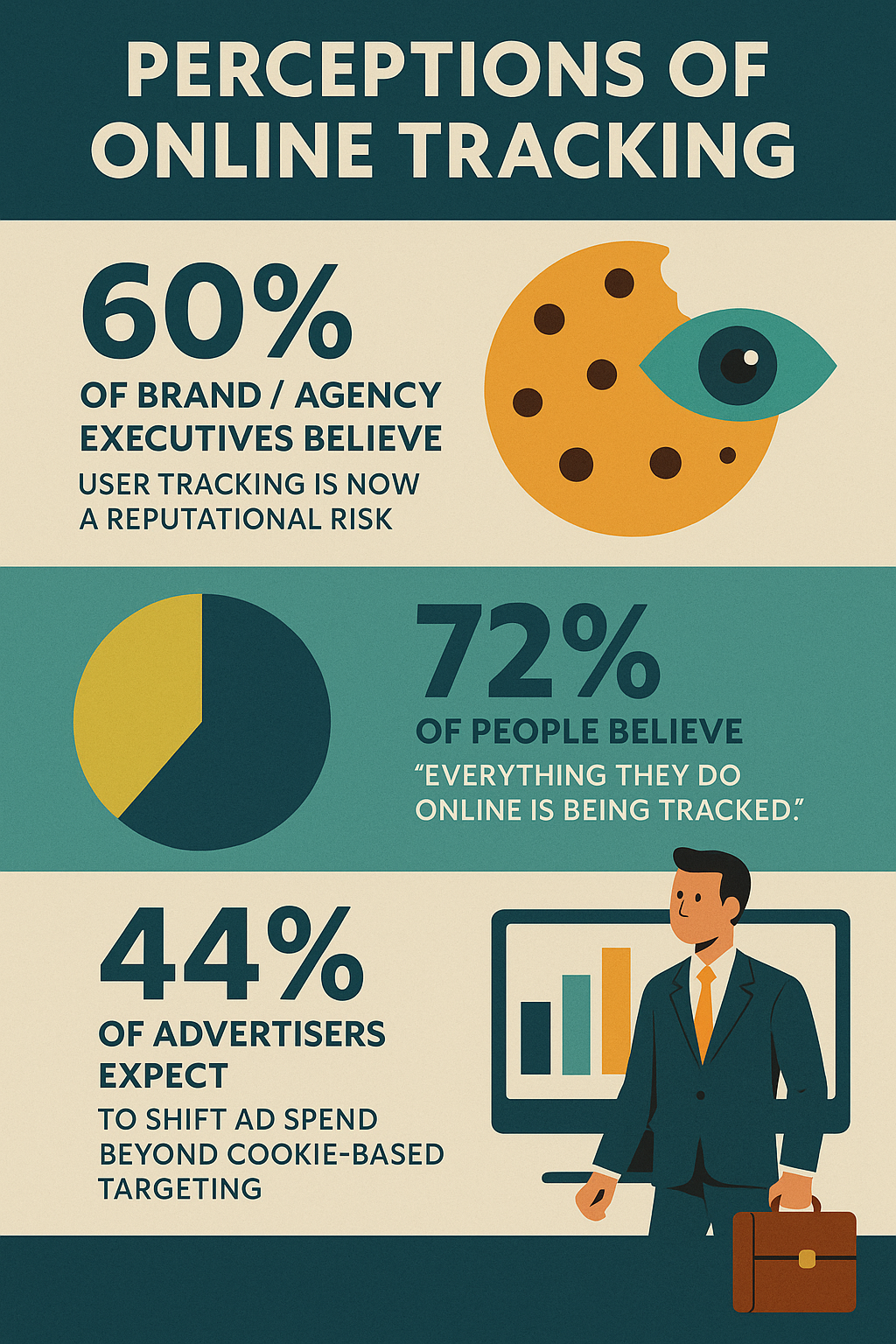
According to recent research:
- One survey found that 60% of brand or agency executives believe user tracking (via cookies and IDs) is now a reputational risk for their brands
- Another found that 72% of people believe “everything they do online is being tracked.”
- A survey of over 200 advertisers showed that 44% expect to shift their advertising spend toward channels outside of traditional cookie-based targeting once the cookie era finishes.
In short: the environment is changing-fast.
Why this shift is happening
There are a number of converging forces driving the move toward a cookieless marketing world. Below are the key ones.
1. Privacy regulation & consumer expectation
Regulations like the General Data Protection Regulation (GDPR) in Europe and the California Consumer Privacy Act (CCPA) in the US are reshaping what companies may do with consumer data. Browsers such as Safari and Firefox have already put restrictions on third-party cookies.
Consumers themselves are increasingly aware and concerned about how their data is used: e.g., 79% of Americans were reported to be concerned about how companies use their data.
2. Browser and platform changes
Major browsers have started to block or limit third-party cookies. These changes mean that legacy ad-tech methods based on cross-site tracking are under practical threat.
Even though there’s still debate about the exact timeline of full phase-out, the trajectory is clear: marketers cannot assume the status quo will persist.
3. Declining reliability of third-party cookies
Interestingly, one insight from the Thai market pointed out that a large portion of third-party cookie-based data may be inaccurate: about 55% of cookie-based data was found to be overstated, and accuracy only around 35%.
Academic work also supports that cookie-based tracking is losing economic value: a study found that limiting cookie lifetime would reduce the value of cookies by up to 25%.
So beyond privacy/regulation, there is a business rationale for adapting.
What marketing looks like today in this cookieless era
The disruption of cookie-based advertising demands a realignment of strategy across targeting, measurement, attribution, and data. Let’s break down how marketing is changing.
Emphasis on first-party data
With third-party cookies faltering, first-party data (data you collect directly from your customers / users) becomes the foundation. According to one white paper:
“Brands must pivot to first-party data strategies, collecting user data directly through their platforms and securely managing it with methods like server-side tagging.”
The benefits? You own the data, you can (with consent) understand your users better, and you avoid some of the risks tied to third-party providers and regulatory exposure.
A critical response is activating consented first-party data for paid acquisition, especially in Google Ads. Our guide on using first-party data in Google Ads for smarter targeting explains how.
Contextual targeting & channel diversification
Where past targeting heavily relied on cookie-based behavioural profiling, the cookieless world gives renewed importance to contextual targeting (aligning ads to content or environment rather than user history).
For example, research from a channel-provider showed that many advertisers plan to shift spend toward search, native, and contextual channels once cookie-based targeting declines.
Measurement and attribution models are evolving
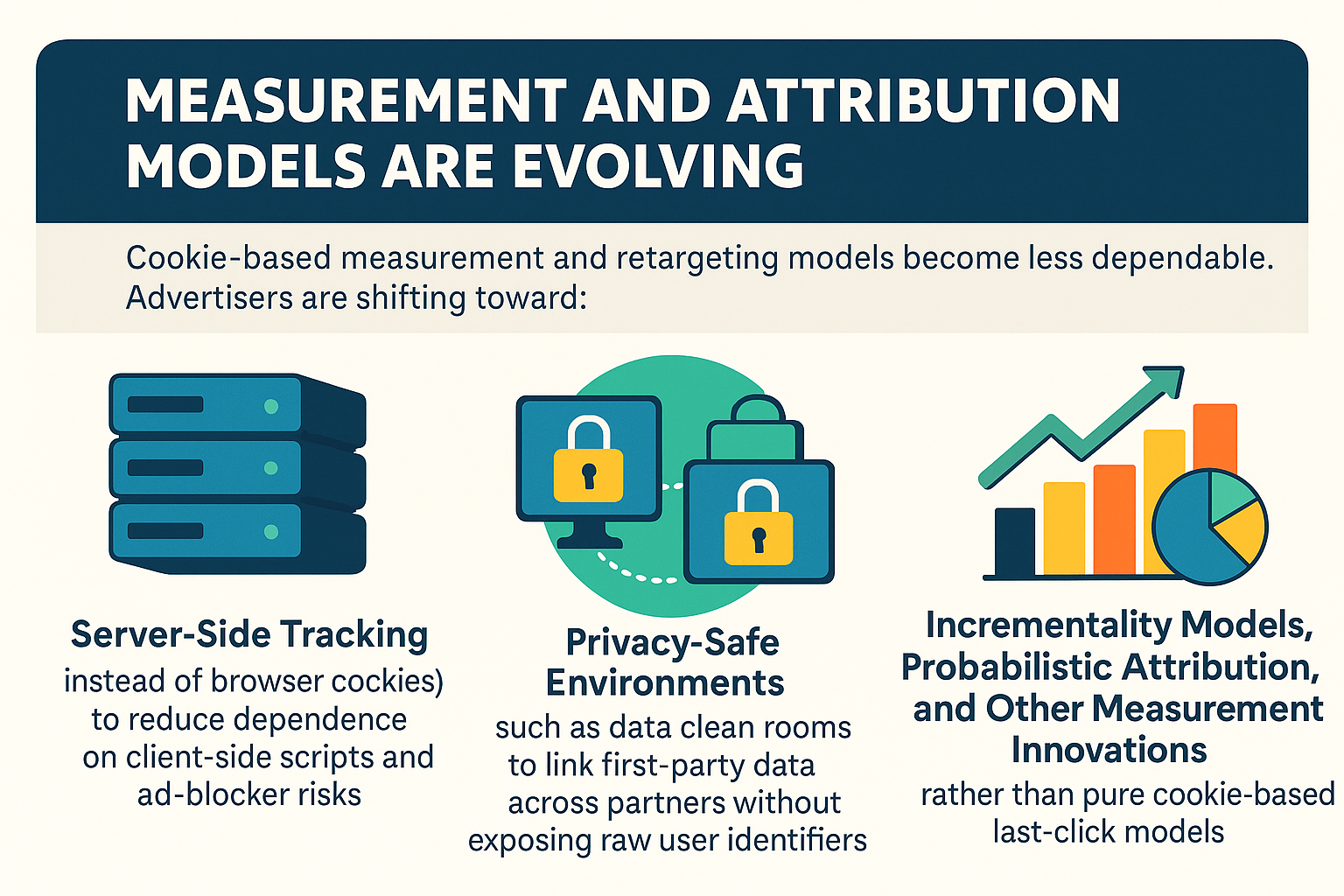
Cookie-based measurement and retargeting models become less dependable. Advertisers are shifting toward:
- Server-side tracking (instead of browser cookies) to reduce dependence on client-side scripts and ad-blocker risks.
- Privacy-safe environments such as data clean rooms to link first-party data across partners without exposing raw user identifiers.
- Incrementality models, probabilistic attribution, and other measurement innovations rather than pure cookie-based last-click models.
Building trust & transparency
In this era, effectiveness hinges not just on reach, but on consent and transparency. Consumers care about how their data is used, and brands that are transparent and respectful gain trust. This trust is a key competitive advantage.
What this means for advertisers & marketers
If you’re living the reality of ‘marketing in a cookieless world,’ here are concrete areas to focus on. This shift impacts every stage of customer acquisition and retention, which we outline in our breakdown of the DTC marketing funnel in a cookieless world.
Audit your current dependencies
- Map all your campaigns, tools and platforms: where do you use third-party cookies, third-party data, or cross-site tracking?
- Identify which parts of your stack are exposed to cookie decline (retargeting, audience segmentation, measurement).
- Assess how much of your budget and performance relies on legacy cookie-based pathways.
Bolster first-party data collection
- Focus on creating value for users so they opt in: e.g., loyalty programs, direct registration, interactive content, surveys.
- Use your CRM, membership data, and user-behaviour logs (with consent) to build rich profiles.
- Make sure your data governance, consent management and systems (e.g., CDP = Customer Data Platform) are well implemented.
Diversify targeting & channel mix
- Invest in contextual targeting, search advertising, native ad formats, and other channels less reliant on third-party cookies.
Reassess your media buying: instead of heavy bias toward cookie-based display, look toward media where user intent signals or contextual signals are strong. - Consider identity-based approaches in closed ecosystems (walled gardens) alongside open web.
Rebuild measurement & attribution
- Implement server-side tracking and reduce reliance on browser cookies.
- Explore data clean rooms or privacy-enhanced analytics for matching datasets without exposing PII.
- Redefine KPIs: focus on incrementality, long-term engagement, brand lift—rather than pure last-click.
- Run testing protocols (A/B, incrementality) to determine what’s working in the new environment.
One of the most effective responses is moving tracking from browsers to servers, explained in our server-side tracking setup guide for Shopify.
Emphasize privacy, transparency & user trust
- Clearly communicate to users how you use their data and why it benefits them.
- Provide options, respect opt-out, and align your systems (consent, data usage, third-party sharing) with regulatory requirements.
- Use this as a brand differentiator: privacy-first can be a competitive advantage in a world of ad fatigue and data mistrust.
Why this is an opportunity, not just a challenge
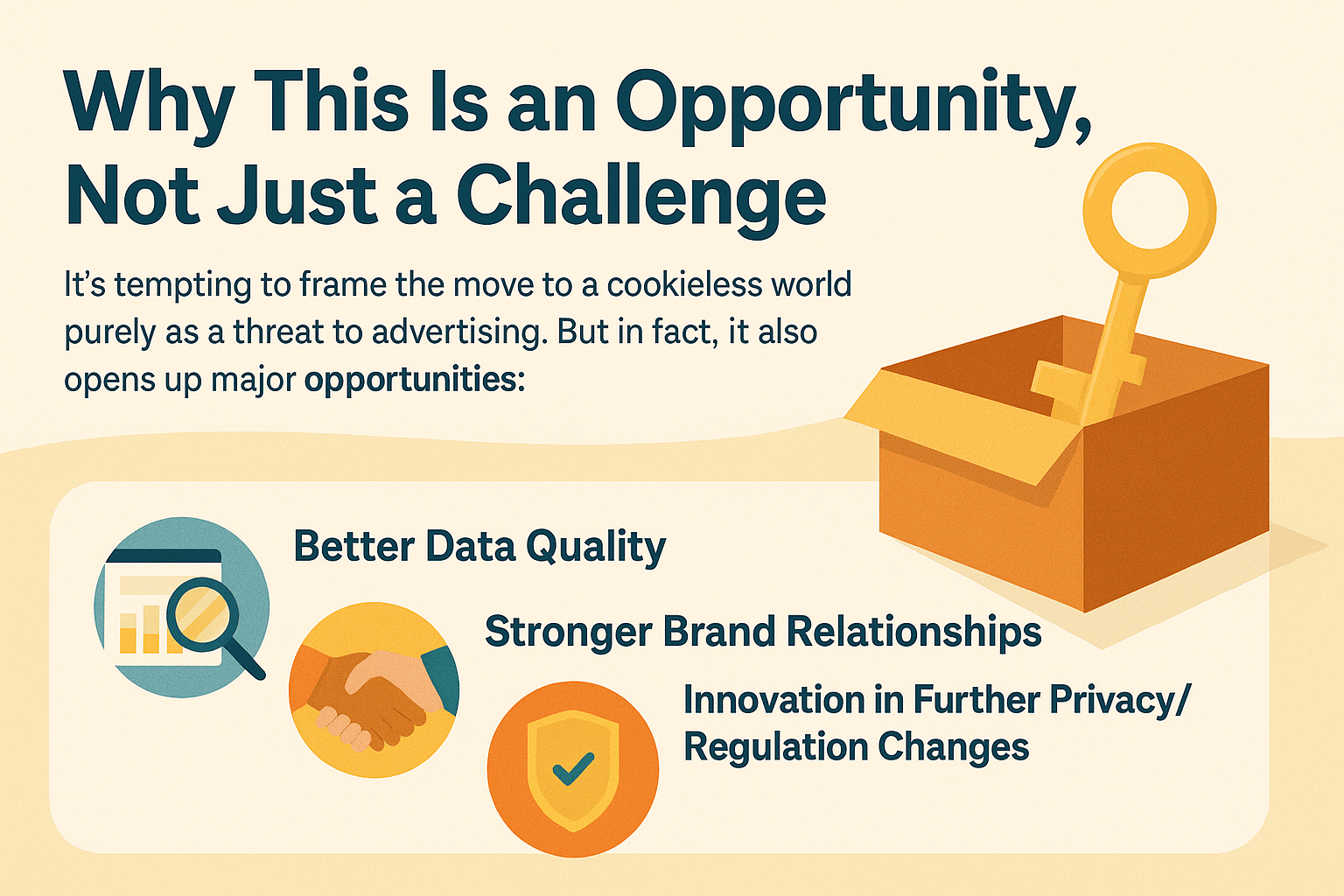
It’s tempting to frame the move to a cookieless world purely as a threat to advertising. But in fact, it also opens up major opportunities:
- Better data quality: First-party data tends to be more accurate, richer, and deeper than cookie-based proxy data which is often outdated or blocked.
Stronger brand relationships: By focusing on user consent and value exchange, you deepen the relationship between brand and customer, rather than treating users as anonymous trackable targets. - Innovation in measurement & creativity: With fewer cookie-based crutches, advertisers are forced to rethink creative, contextual relevance, and attribution, which can drive better user-centric campaigns.
- Resilience to further privacy/regulation changes: By building first-party, contextual and privacy-aware strategies now, you position your marketing for long-term sustainability. Many articles emphasise that preparing for a cookieless world is not wasted work-even if the timeline shifts
Real-world implications: what to watch out for
Emerging methods such as fingerprinting are increasingly filling identity gaps — though not without controversy. Learn more in our analysis of fingerprinting in marketing and tracking without cookies.
- Retargeting will likely get harder. Audiences who were tracked across sites via third-party cookies will shrink, so you may face more limited reach, higher CPMs, or more effort required for the same results.
- New tools may concentrate power in large ecosystems. For example, research indicates that as cookies fade, larger ad networks or platforms might consolidate advantage through new privacy-safe APIs.
- Cost structures might shift. With fewer “cheap” cookie-based buys and more emphasis on quality, measurement, and data infrastructure, upfront investments may rise even if long-term ROI improves.
- Performance metrics may decrease temporarily. Several sources warn that in the short term, as marketers transition, click-through rates, reach and targeting precision may drop until new models settle in.
How to stay ahead: A checklist
Here’s a practical checklist for marketing leaders and practitioners navigating this space:
- Audit current cookie reliance: mapping third-party cookies, vendors, tracking mechanisms.
- Build or enhance your first-party data infrastructure: CDP, consent management, CRM integration.
- Define new target audiences and channels that don’t rely solely on cookies: contextual, search, native.
- Update measurement strategy: server-side tracking, clean rooms, modelled attribution.
- Revisit creative and brand message: emphasise value, relevance, privacy.
- Educate your team and stakeholders about this shift: why it matters, what changes.
- Monitor industry developments: browser policies, regulatory updates, new ad-tech solutions.
- Run pilot campaigns now, test and iterate: you want early advantage rather than being forced to react later.
Looking ahead: The future of digital advertising
As we look toward the next few years, it’s clear that the era of “cookie-driven mass audience targeting” is fading. What’s emerging is a digital advertising ecosystem where:
- Privacy is baked-in: Consent, user control, transparency become standard.
- Context and environment matter: Not just who the user is, but what they’re doing and where.
- The brand-user relationship becomes deeper: Because you rely more on owned data and value exchange.
- Measurement becomes smarter: Attribution models adapt, clean rooms proliferate, identity becomes more sophisticated.
As one expert wrote:
“The shift towards a cookie-less world is reshaping the digital advertising landscape… While the decline of third-party cookies poses challenges, it also presents opportunities for innovation and improved user experiences.”
So for forward-looking marketers, this is a chance to redefine how you engage your audience, differentiate your brand, and build long-term value=not just chase clicks.
FAQ
Q1: What exactly does “cookieless marketing” mean?
A: Cookieless marketing refers to strategies for targeting, engaging and measuring audiences without relying solely on third-party cookies. It emphasises first-party data, contextual signals, server-side tracking and privacy-first architectures.
Q2: Are third-party cookies going to disappear completely?
A: Not necessarily immediately. The exact timeline varies depending on browser and region. For example, Google Chrome delayed full deprecation. But the quality and viability of third-party cookie targeting is already degrading.
Q3: If cookies are less reliable, can I still target effectively?
A: Yes—but you’ll need to shift tactics. You can still use first-party data, contextual targeting, identity-based segments, and newer tools like data clean rooms. The key is aligning your data collection, consent, channels and measurement to this new paradigm.
Q4: What kinds of marketing channels work well in a cookieless world?
A: Channels that make less reliance on cross-site cookie tracking tend to be more resilient: search advertising, native advertising, contextual display, well-managed mobile app strategies, loyalty-driven programmes. One study showed 44% of advertisers expect to shift spend toward these channels.
Q5: How should I measure success if legacy attribution models don’t apply?
A: You’ll want to explore measurement methods such as: incrementality testing, modelled conversions, matched first-party data via clean rooms, server-side tagging, measurement frameworks aligned with consent and privacy. Define KPIs like engagement, value per user, brand lift rather than solely last-click conversions.
Final Thoughts
Marketing in a cookieless world is not just a technical change=it’s a strategic inflection point. It forces brands and marketers to rethink how they collect, activate and measure data; how they engage users; and how they build trust.
If you start now-auditing your dependencies, strengthening your first-party data, diversifying your channels, evolving your measurement-you’ll not only protect yourself from the erosion of cookie-based targeting but also gain a competitive edge.
In the end, the brands that thrive will be those that understand that this change is not about what’s being lost, but what’s being unlocked: richer user relationships, more responsible data practices, and smarter, more sustainable advertising.
Here’s to taking the cookieless era by the reins-rather than being left behind.